If you’re applying for a green card, completing Form I-693 (Report of Medical Examination and Vaccination Record) is a required step in your adjustment of status process. One of the most common questions applicants ask is:
“What lab tests do I actually need for Form I-693?”
The answer depends on your age, medical history, and vaccination documentation — but there are specific federally mandated screenings every applicant must complete.
If you’re looking for a full overview of the immigration medical process, you can read our comprehensive guide here:
👉 The Ultimate I-693 Medical Lab Guide for Immigrants
https://labondemandind.com/the-ultimate-i-693-medical-lab-guide-for-immigrants/
Below is a clear breakdown of the required laboratory tests and how they apply to your immigration medical exam.
Why Are Lab Tests Required for I-693?
The immigration medical exam is designed to screen for communicable diseases of public health significance. These screenings follow CDC Technical Instructions and must be performed under the supervision of a USCIS-designated civil surgeon.
Lab results are recorded directly on Form I-693 and submitted in a sealed envelope to USCIS.
Failing to complete the required labs can delay your green card process.
Required Lab Tests for Form I-693
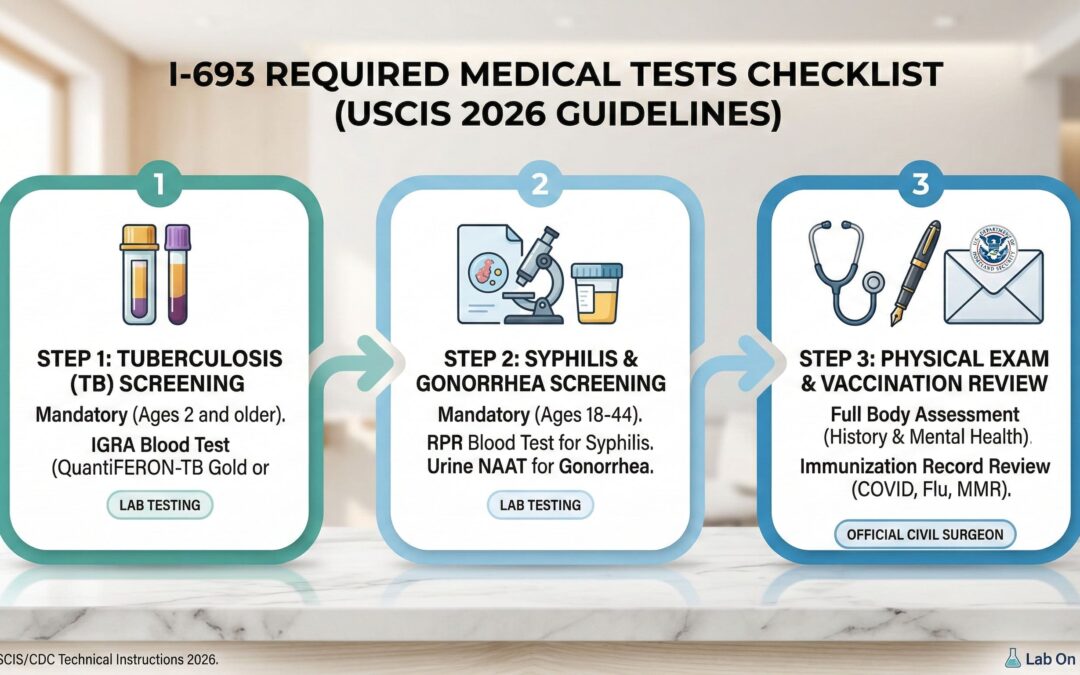
1. Tuberculosis (TB) Screening
Required for applicants aged 2 years and older
Tuberculosis screening is mandatory for nearly all applicants.
The required test is an:
-
IGRA blood test (Interferon Gamma Release Assay)
Common examples include QuantiFERON-TB Gold or T-Spot.
The older skin test (PPD) is no longer the preferred method for immigration exams.
What Happens If the TB Test Is Positive?
If your TB blood test is positive, the civil surgeon will order:
-
A chest X-ray
This determines whether you have:
-
Latent TB (not contagious)
-
Active TB disease (requires treatment before clearance)
TB clearance is one of the most important components of Form I-693.
2. Syphilis Blood Test
Required for applicants aged 15–44
USCIS requires syphilis screening for individuals in this age group.
This is done through a blood test, typically:
-
RPR (Rapid Plasma Reagin)
-
Or another approved treponemal test
If the initial screening is reactive, confirmatory testing is required. If infection is confirmed, treatment documentation must be provided before the civil surgeon can complete your I-693.
Applicants outside the 15–44 age range are not routinely required to undergo syphilis testing unless clinically indicated.
3. Gonorrhea Testing
Required for applicants aged 15–24
Gonorrhea screening is required for this age group under CDC immigration medical guidelines.
This is usually performed via:
-
Urine test (NAAT testing)
If positive, treatment must be documented prior to finalizing the I-693.
Applicants outside the 15–24 age range are typically not required to undergo gonorrhea testing unless symptoms or risk factors are present.
Are Additional Labs Ever Required?
Beyond the core mandatory tests, additional lab work may be ordered depending on your vaccination records.
Vaccine Immunity Titers (When Records Are Missing)
If you do not have reliable vaccination documentation, your civil surgeon may order antibody blood tests (titers) to confirm immunity.
Common titers include:
-
Measles, Mumps, Rubella (MMR)
-
Varicella (chickenpox)
-
Hepatitis B
Titers are not universally required — they are only used when vaccination history is unclear and documentation is needed for Form I-693 completion.
Do You Need to Get Labs Done Before Seeing the Civil Surgeon?
No.
All required lab tests must be:
-
Ordered by the USCIS-designated civil surgeon
-
Completed according to CDC Technical Instructions
-
Properly documented on Form I-693
Getting labs done independently will not satisfy immigration requirements unless coordinated through the civil surgeon.
How Long Do Lab Results Take?
Most required lab tests return within:
-
1–3 business days
If additional testing (such as chest X-ray or confirmatory STI testing) is needed, the timeline may extend slightly.
Planning ahead helps prevent delays in submitting your adjustment of status packet.
Quick Reference Summary
Here is a simplified breakdown:
| Lab Test | Required Age Range |
|---|---|
| TB (IGRA Blood Test) | Age 2+ |
| Syphilis Blood Test | Age 15–44 |
| Gonorrhea (Urine NAAT) | Age 15–24 |
| Vaccine Titers | Only if vaccination records are incomplete |
Why Accuracy Matters
Submitting an incomplete or incorrect Form I-693 can result in:
-
Request for Evidence (RFE)
-
Processing delays
-
Additional medical appointments
Working with a clinic experienced in immigration lab requirements ensures:
-
Correct age-based testing
-
Proper documentation
-
Faster turnaround
-
Fewer complications
For a complete overview of how the entire immigration medical process works — including vaccinations, physical exams, and submission tips — read our detailed guide:
👉 The Ultimate I-693 Medical Lab Guide for Immigrants
https://labondemandind.com/the-ultimate-i-693-medical-lab-guide-for-immigrants/
We service Carmel, Indianapolis, Westfield, Fishers and surrounding areas
Final Thoughts
If you’re preparing for your green card medical exam, knowing exactly what lab tests are required helps you plan confidently.
In most cases, you will need:
-
TB blood test
-
Syphilis test (if age 15–44)
-
Gonorrhea test (if age 15–24)
Additional titers may be ordered if vaccination documentation is incomplete.
Understanding these requirements ahead of time prevents unnecessary delays and keeps your immigration process moving forward smoothly.